Company milestone · 1933-07-08
Art Rooney’s team joined the NFL as the Pittsburgh Pirates. [1]
Logo files, variants & history · AI, PNG · updated 2 mo ago
Brand profile
Professional American football team
The Pittsburgh Steelers are a professional American football team based in Pittsburgh. They compete in the National Football League (NFL) as a member of the AFC North division.
The team joined the NFL as the Pittsburgh Pirates on 8 July 1933. It was owned by Art Rooney and took its original name from the city’s baseball team; before the 1940 season Rooney renamed it the Steelers.
Black and gold have been the team’s colours since its founding, except in 1943, when it merged with the Philadelphia Eagles. They are the colours of the city’s official flag.
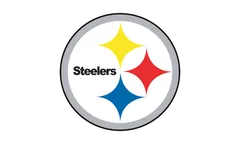
The team logo is based on the Steelmark of the American Iron and Steel Institute, and the Steelers place it on only the right side of the helmet.
Company: National Football League.
Available in this archive
Pittsburgh Steelers has 2 downloadable files in AI, PNG in this archive. 1 logo record is catalogued; that is not the number of verified redesigns.
PNG renditions reach 3,000 pixels on the longest side.
Choose a format and size ↓File library
Browse recorded formats and variants for Pittsburgh Steelers. Source formats appear first, followed by raster sizes.
NFL Pittsburgh Steelers · Current
NFL Pittsburgh Steelers · Current
A file link or download does not grant a trademark licence or permission to reuse a logo.
Brand heritage
One logo record is catalogued. The milestones below are dated separately from it.
Steelers logos from the 1940 plaque design to the Steelmark adopted in 1962 and changed to read Steelers in 1963, as recorded by the team, the American Iron and Steel Institute and Wikipedia. The AISI credits U.S. Steel with creating the Steelmark; Wikipedia names the design firm. Company and product dates are labelled separately from design changes.
Company milestone · 1933-07-08
Art Rooney’s team joined the NFL as the Pittsburgh Pirates. [1]
Company milestone · 1940
Before the start of the 1940 season, Rooney renamed the team the Steelers. [4]
Logo milestone · 1940
To mark the new name, Rooney was given a plaque with a football-shaped design honouring the city’s steel industry and the words “Pittsburgh Steelers Football Club” around the edge. It became the first Steelers logo and was used almost only on letterhead. [4]
Logo milestone · 1962
Cleveland-based Republic Steel offered the Steelmark, a circle enclosing three hypocycloids and the word Steel, as a helmet logo. Equipment manager Jack Hart was told to apply it to one side of the gold helmets as a test. [3] [4] [5]
Visual identity milestone · 1963
After first wearing black helmets for the Playoff Bowl at the end of the 1962 season, the team adopted black helmets full-time; the one-sided logo placement was kept. [2] [5]
Logo milestone · 1963
After a petition to the American Iron and Steel Institute, the team received permission to change the word Steel in the logo to Steelers. [2] [3] [5]
Compiled 2026-09-25 by AI-assisted source review. Each statement links its sources; an editor has not yet independently confirmed them.
Colour sample
Approximate values sampled from the archived artwork file. Sampling can round colours, so these are not the owner’s published colour specification.
Design context
The Steelmark was created for a U.S. Steel campaign and later passed to the American Iron and Steel Institute. Its hypocycloids came to represent the materials used to make steel: yellow for coal, orange for iron ore and blue for steel scrap.
The team has made subtle changes from the Steelmark, making the hypocycloids thicker and changing the orange one to red.
A “Man on the Beam” logo gained a public profile in newspaper coverage in the late 1950s; in 1998 the NFL chose it for Steelers throwback merchandise.
From the researched record (AI-assisted source review); see research sources.
Logo lettering can differ from a brand’s corporate typefaces.
Reference
Steelmark, the basis of the Steelers logo (1958) is credited to Lippincott & Margulies (agency). The designer of the specific file version shown on this page is not recorded. [3]
Download for identification, news and comparison. Commercial use needs the owner's permission. This page never grants a licence. Always check the owner's brand guidelines.
1940: To mark the new name, Rooney was given a plaque with a football-shaped design honouring the city’s steel industry and the words “Pittsburgh Steelers Football Club” around the edge. It became the first Steelers logo and was used almost only on letterhead. 1962: Cleveland-based Republic Steel offered the Steelmark, a circle enclosing three hypocycloids and the word Steel, as a helmet logo. Equipment manager Jack Hart was told to apply it to one side of the gold helmets as a test. 1963: After a petition to the American Iron and Steel Institute, the team received permission to change the word Steel in the logo to Steelers. [2] [3] [4] [5]
Available file formats: AI, PNG. Dimensions, source and usage conditions are listed for each file below.
Visual neighbours
No other archived mark is listed as a close match; that is not a uniqueness or trademark check. The similarity check shows weaker candidates.
Same company
Listed because the archive records the same company.
Same industry
Listed because the archive records the same industry, United States first.
Provenance
SimilarLogo archive files, not yet independently reviewed.
SHA-256 of the recorded file. Checksums identify exact bytes, not who created the artwork.
SimilarLogo. “Pittsburgh Steelers logo record.” Updated 2026-08-27. https://similarlogo.com/brand/pittsburgh-steelers/
These files come from SimilarLogo's archive of Pittsburgh Steelers artwork (archive snapshot 2026-08-02). Formats and file details are shown in the library.
All logos and trademarks on SimilarLogo are the property of their respective owners and are provided for informational, editorial and identification purposes only. Availability here does not imply any licence, affiliation or endorsement. Rights holder? Claim this brand · Request removal · Report an error. Staff review each request; there is no automatic takedown.
Help us understand which catalogues and file formats are useful. We do not record search text, uploaded images, names, email addresses or IP addresses in usage events. Events expire after 30 days. Local, staff and recognised bot traffic is separate.
Measurement is off until you opt in. Downloads have separate operational delivery counts.