Company milestone · 1919-08-11
Earl “Curly” Lambeau and George Whitney Calhoun founded the Green Bay Packers. [1]
Logo files, variants & history · AI, PNG · updated 2 mo ago
Brand profile
Professional American football team
The Green Bay Packers are a professional American football team based in Green Bay, Wisconsin. They compete in the National Football League (NFL) as a member of the NFC North division.
Earl “Curly” Lambeau and George Whitney Calhoun founded the team on 11 August 1919, and it joined the American Professional Football Association, the forerunner of the NFL, in 1921.
The team is named after the Indian Packing Company, Lambeau’s employer, which gave $500 for uniforms and equipment on condition that the team carry its sponsor’s name.
The Packers are a non-profit, community-owned team, and they have played home games at Lambeau Field since 1957.
Sources: [1]
Company: National Football League.
Available in this archive
Green Bay Packers has 2 downloadable files in AI, PNG in this archive. 1 logo record is catalogued; that is not the number of verified redesigns.
PNG renditions reach 3,000 pixels on the longest side.
Choose a format and size ↓File library
Browse recorded formats and variants for Green Bay Packers. Source formats appear first, followed by raster sizes.
NFL Green Bay · Current
NFL Green Bay · Current
A file link or download does not grant a trademark licence or permission to reuse a logo.
Brand heritage
One logo record is catalogued. The milestones below are dated separately from it.
Packers logos from the first official logo of 1950 to the helmet G of 1961 and its change to an oval by 1970, as recorded by the team and cited reporting. Company and product dates are labelled separately from design changes.
Company milestone · 1919-08-11
Earl “Curly” Lambeau and George Whitney Calhoun founded the Green Bay Packers. [1]
Logo milestone · 1950
The team’s first official logo appeared: the word Packers in green capitals with an enlarged P, set over a football and two goalposts. [3]
Logo milestone · 1954
A new logo showed a silhouette of Wisconsin inside a football, with a player cocking his arm to throw a pass. [3]
Logo milestone · 1959
With Vince Lombardi’s arrival, an overlapping block G and B was designed for caps, shirts and jackets. [3]
Logo milestone · 1961-08-05
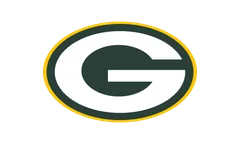
The G logo was worn on the helmet for the first time, at the team’s annual intra-squad game at old City Stadium. Lombardi had asked equipment manager Gerald “Dad” Braisher for a logo, and Braisher’s assistant John Gordon, an art student at St. Norbert College, sketched a football-shaped G. [1] [2] [4]
Logo milestone · 1970
Team historian Cliff Christl, working from old photographs, found that the football-shaped G had been changed to an oval before the 1970 season; he notes the new G may have been phased in. [2]
Compiled 2026-09-25 by AI-assisted source review. Each statement links its sources; an editor has not yet independently confirmed them.
Colour sample
Approximate values sampled from the archived artwork file. Sampling can round colours, so these are not the owner’s published colour specification.
Design context
Christl states that the G stands for Green Bay, and that the claim it stands for “greatness” began with a story told by Tiki Barber before Super Bowl XLV.
The G is the only logo that has appeared on the Packers’ helmet.
The team has used a metallic gold plastic helmet since 1951, and hunter green and athletic gold have been its colours since 1958.
From the researched record (AI-assisted source review); see research sources.
Reference
Packers G logo (1961) is credited to John Gordon. The designer of the specific file version shown on this page is not recorded. [1] [2] [4]
Download for identification, news and comparison. Commercial use needs the owner's permission. This page never grants a licence. Always check the owner's brand guidelines.
1950: The team’s first official logo appeared: the word Packers in green capitals with an enlarged P, set over a football and two goalposts. 1954: A new logo showed a silhouette of Wisconsin inside a football, with a player cocking his arm to throw a pass. 1959: With Vince Lombardi’s arrival, an overlapping block G and B was designed for caps, shirts and jackets. 1961-08-05: The G logo was worn on the helmet for the first time, at the team’s annual intra-squad game at old City Stadium. Lombardi had asked equipment manager Gerald “Dad” Braisher for a logo, and Braisher’s assistant John Gordon, an art student at St. Norbert College, sketched a football-shaped G. 1970: Team historian Cliff Christl, working from old photographs, found that the football-shaped G had been changed to an oval before the 1970 season; he notes the new G may have been phased in. [1] [2] [3] [4]
Available file formats: AI, PNG. Dimensions, source and usage conditions are listed for each file below.
Visual neighbours
Ranked from image embeddings, perceptual hashes and geometric evidence. Ranks are not percentages or trademark clearance.
Same company
Listed because the archive records the same company.
Same industry
Listed because the archive records the same industry, United States first.
Provenance
SimilarLogo archive files, not yet independently reviewed.
SHA-256 of the recorded file. Checksums identify exact bytes, not who created the artwork.
SimilarLogo. “Green Bay Packers logo record.” Updated 2026-08-27. https://similarlogo.com/brand/green-bay-packers/
These files come from SimilarLogo's archive of Green Bay Packers artwork (archive snapshot 2026-08-02). Formats and file details are shown in the library.
All logos and trademarks on SimilarLogo are the property of their respective owners and are provided for informational, editorial and identification purposes only. Availability here does not imply any licence, affiliation or endorsement. Rights holder? Claim this brand · Request removal · Report an error. Staff review each request; there is no automatic takedown.
Help us understand which catalogues and file formats are useful. We do not record search text, uploaded images, names, email addresses or IP addresses in usage events. Events expire after 30 days. Local, staff and recognised bot traffic is separate.
Measurement is off until you opt in. Downloads have separate operational delivery counts.